Church of Santa Maria di Loreto
Altidona
The Church of Santa Maria di Loreto is located on the hill of Altidona and enjoys a privileged position that...

 Italiano
 English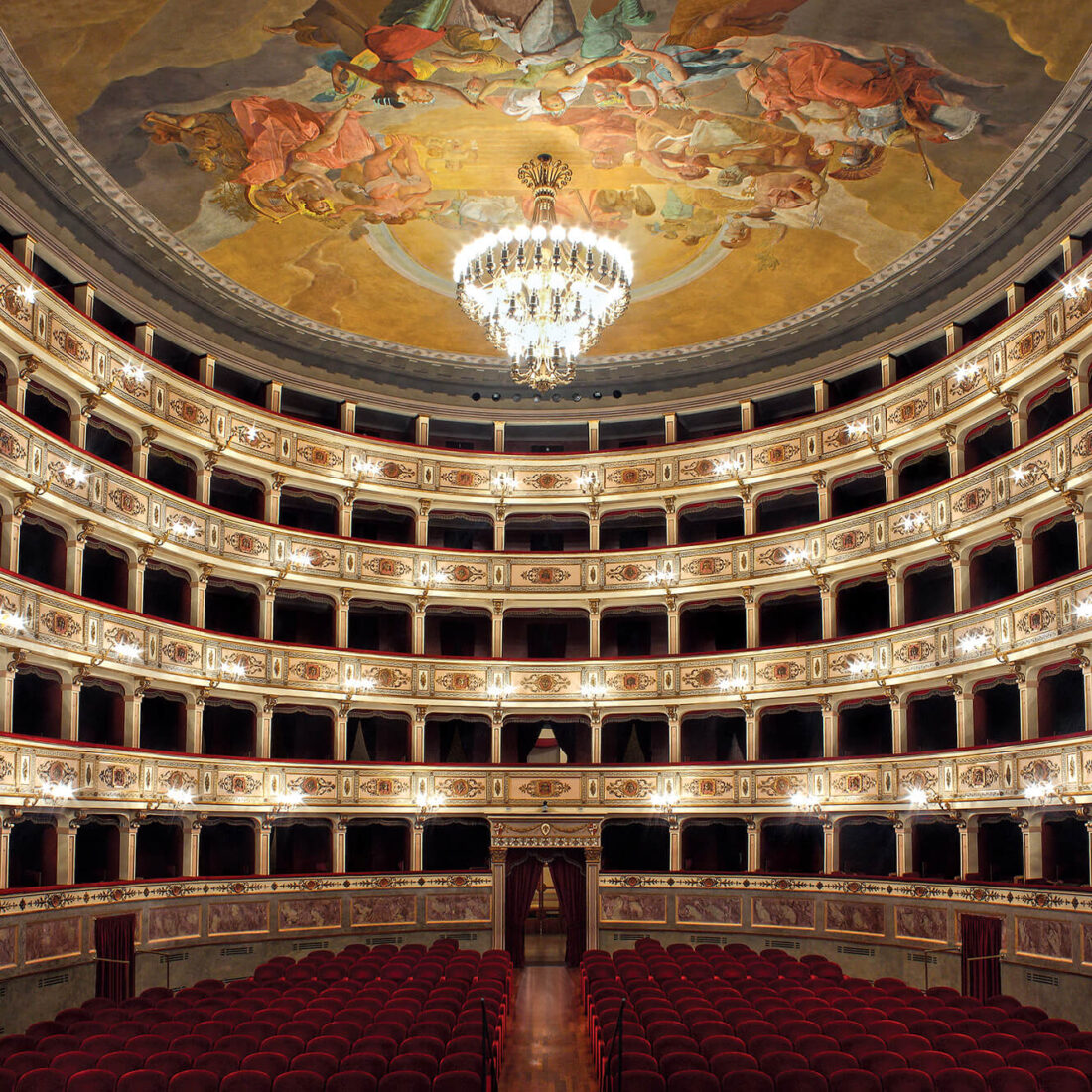
Inaugurated in 1792 based on the design by architect Cosimo Morelli, the Teatro dell’Aquila in Fermo is one of the largest and most prestigious historic theaters in the Marche region. It replaced the ancient wooden hall of Palazzo dei Priori and is named after the bird of prey that symbolizes the city.
The Teatro dell’Aquila represents the vibrant heart of social and cultural life in Fermo, established in the late 18th century in response to the growing need for a monumental and modern performance space. Its construction, which began in 1780 under the design of the famous Imola architect Cosimo Morelli and executed by master builder Luigi Paglialunga, was a long and complex process, influenced by the specific choice of site on Via Mazzini. This location affected the structure, which develops longitudinally in relation to the street, depriving the building of a main facade and placing the entrance on one side, a peculiarity that distinguishes it among the landscape of major Italian theaters.
The current configuration of the hall is the result of profound renovations that took place after a dramatic fire that, on the night of January 23 to 24, 1826, destroyed part of the boxes and the ceiling. Under the direction of architect Giuseppe Ghinelli, the theater adopted the 19th-century stylistic imprint that characterizes it today, with a lowered auditorium to improve acoustics and 124 boxes arranged in five tiers. The decorative apparatus is remarkably crafted: the railings of the boxes feature golden stuccos crafted by Biagio Baglioni, while the gaze of the spectator is inevitably captured by the majestic Parisian chandelier with 56 arms, purchased in 1830, and by the “face” of the hall, a figurative tempera created by Luigi Cochetti depicting elegantly grand mythological scenes.
In addition to its architectural magnificence, the theater is renowned for its artistic excellence and the original stage mechanisms of Antonio Pizzoli. Since its inauguration in 1791 with the drama “The Destruction of Jerusalem,” the Fermano stage has seen the most illustrious names from the international panorama perform, from icons of opera to contemporary prose protagonists like Toni Servillo and Pierfrancesco Favino, as well as prominent interpreters of popular music. Today, thanks to constant restoration interventions and collaboration with prestigious institutions like AMAT and the Rete Lirica delle Marche Foundation, the Teatro dell’Aquila continues to be a vital production center, capable of uniting the preservation of its glorious past with the training of young people through acting schools and dedicated festivals.
A14 motorway, Fermo–Porto San Giorgio exit: follow signs for Fermo town centre, about 8 km away. Alternatively, take the SS16 Adriatica road and then continue uphill towards the historic centre.
Porto San Giorgio railway station, about 10 km from Fermo. Shuttle bus service to Fermo town centre. Direct rail connections with Ancona, Pescara and Bologna.
Girfalco car park: free, 200 spaces, with lift access to the centre. Station car park: free, 150 spaces. Cathedral car park: paid parking, 80 spaces. A Limited Traffic Zone is active in the historic centre.
The Church of Santa Maria di Loreto is located on the hill of Altidona and enjoys a privileged position that...
An ecomuseum is a cultural reality that arises directly from a territory and its community, with the aim of researching,...
The beach of Marina di Altidona features a wide expanse of sand mixed with pebbles and gravel. It's easily accessible from the coast, surrounded by a convenient bike path.