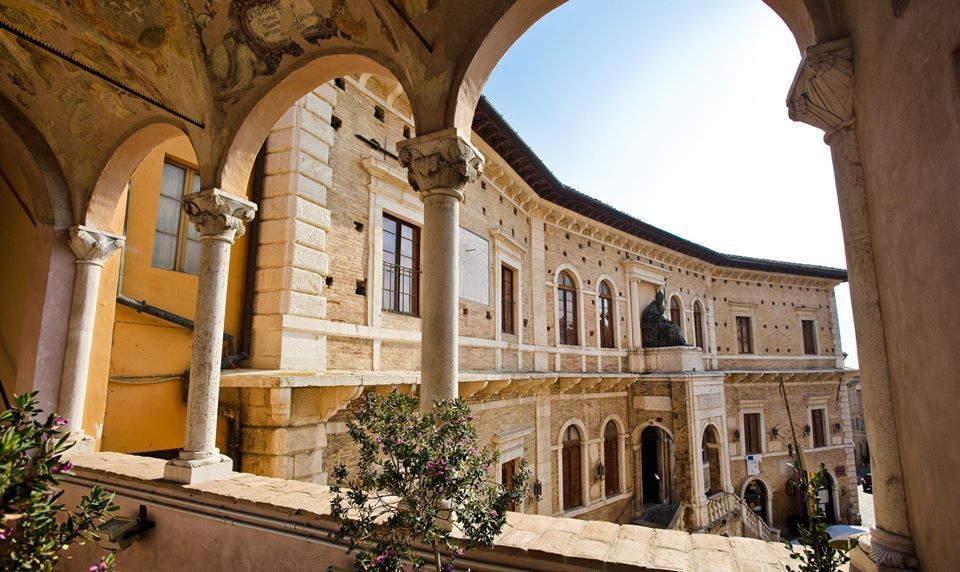
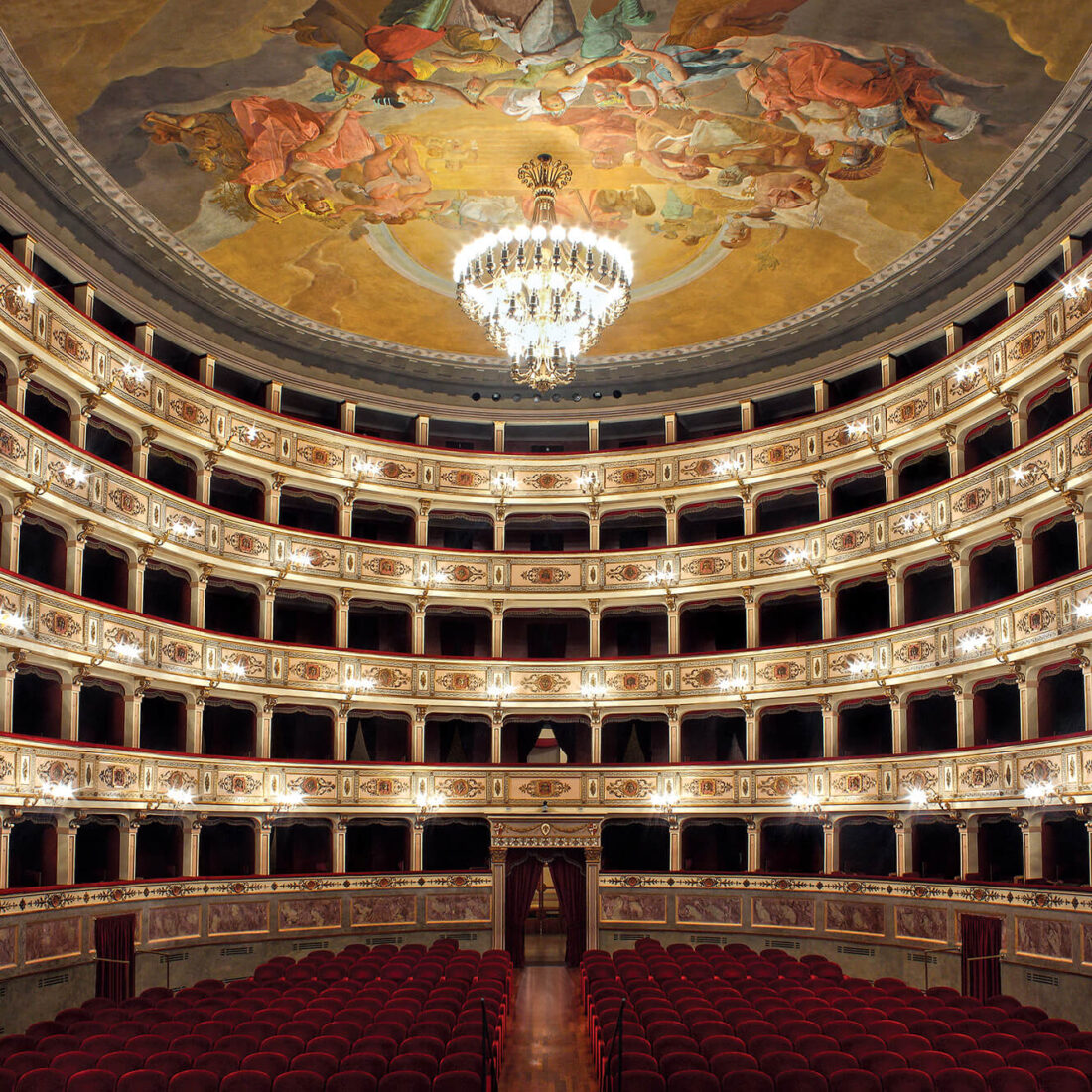
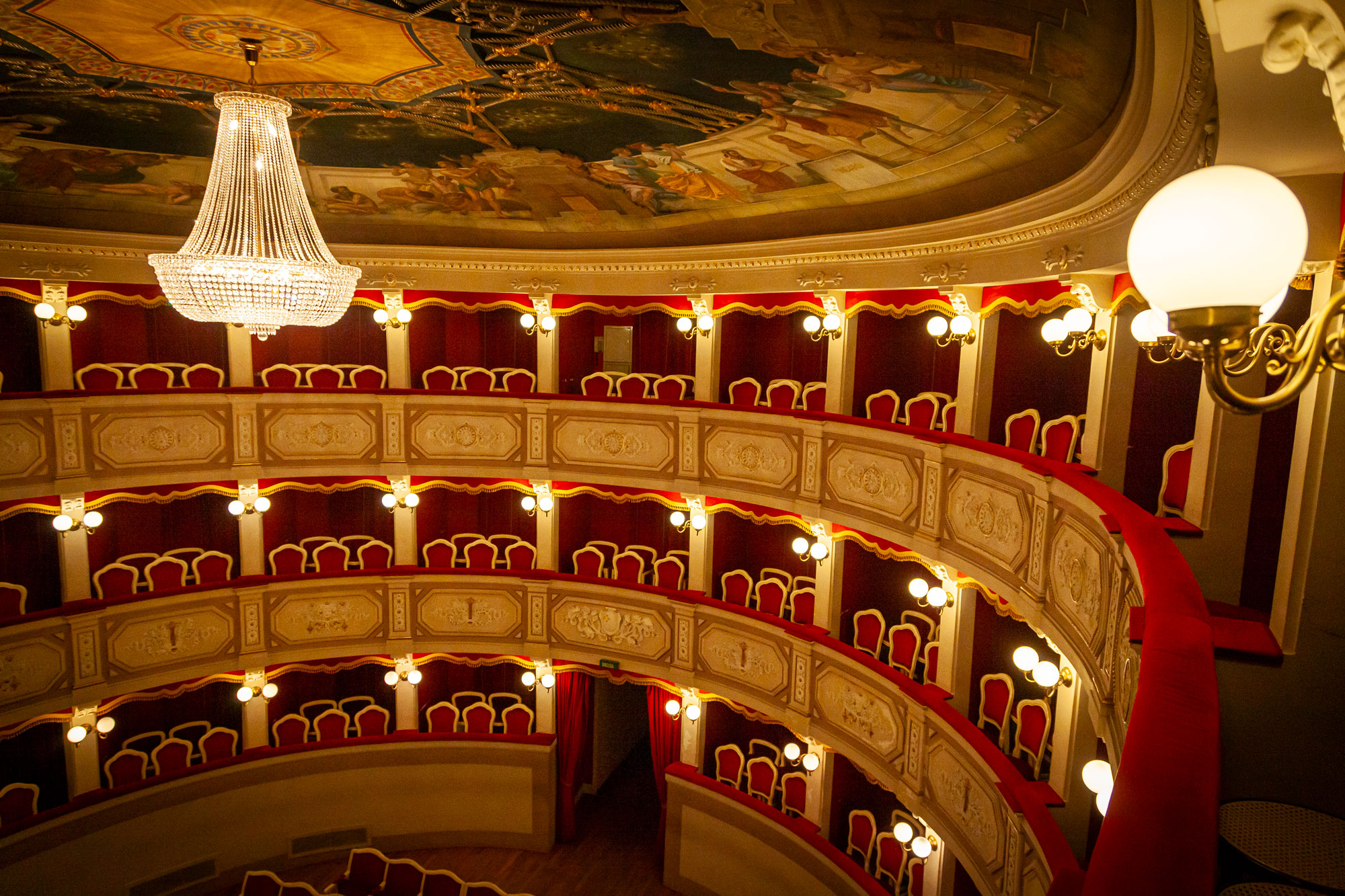
Built at the end of the 14th century from the union of two previous buildings (the palace of Rinaldo di Giorgio and the church of San Martino), it became the seat of the College of Priors in 1396. The current façade results from a remodeling at the end of the 1500s when the statue of Pope Sixtus V, created by Accursio Baldi, was placed at the center of the double staircase. Today, it is the headquarters of the city’s museum complex. Inside, the World Map Room, the first room of the public library, was desired in 1688 by Cardinal Decio Azzolino the Younger, and the Portrait Hall, the former seat of the city’s theater. The Palace also hosts, among the representative rooms, the City Council Hall known as “the Eagle” and the Mayor’s Office.
Palazzo dei Priori: the structure
The building, restored in the first half of the 15th century and completed in 1525, features a central double staircase leading to an entrance porch where the bronze statue of Sixtus V (bishop of Fermo from 1571 to 1577) is placed, a work created by the Tuscan Accursio Baldi, known as Sansovino, in 1588.
The entire structure has a particular fan-shaped opening, the facade is highlighted at the corners by rusticated cladding and is divided by floor cornices. A stone cornice, supported by brackets, is placed between the two upper floors.
In the atrium on the first floor, there is a wall relief representing the Coat of Arms of Pope Boniface IX with the inscription: BONIFACIO VIIII / TOMACELLO NEAPOLITANO / PONTI(ifex) OPT(imo) MAX(imo) / BENEFACTORI S(enatus) P(opolus) Q(uae) F(irmanus), which refers to the privilege granted by the Pope to Fermo for a Studium.
The Representative Halls
From the atrium of the Palazzo dei Priori, one accesses the representative rooms on the first floor.
The Hall of Portraits is the largest in the building; along the walls, thirty portraits are hung, among which nine are of Fermano cardinals: Girolamo Azzolino, Decio Azzolino senior, Decio Azzolino junior, Tommaso Bernetti, Carlo Pelagallo, Domenico Spinucci, Urbano Paracciani, Cesare Brancadoro, and Gabriele Ferretti. Completing the collection are twenty portraits of illustrious men donated by Cardinal Alessandro de Medici to Cardinal Domenico Pinelli.
In the Hall of Costumes, there are preserved garments of priors, coats, and livery of servants, trumpeters, and pages, in use since the 17th century. In the antechamber of the Mayor’s Hall, known as the Hall of Coats of Arms, the city coat of arms dominates the center of the ceiling. The motto FIRMUM FIRMA FIDES ROMANORUM COLONIA is a phrase, probably from the Renaissance period, still used today, surrounding the coats of arms of the forty-eight municipalities in the district.
The Mayor’s Hall, used for official ceremonies and marriages, is elegantly furnished with exquisitely made armchairs, consoles, and mirrors, and houses the Municipal Gonfalone.
In the Yellow Room, precious furniture donated to the Municipality is stored, and in a display case, some figurines of fine porcelain (late 18th century) made by the Ginori workshop are exhibited.
The Council Chamber, also known as the Room of the Eagle due to the presence of decorations based on this motif. The perspective paintings that decorate the ceiling are the work of Pio Panfili (1762), who celebrated through allusive architectures, symbols, and images the academies that flourished during that period in the City.